
As AI-powered fraud becomes increasingly sophisticated, securing digital identity verification requires more than confirming that a real person is in front of a camera. It also requires ensuring that the biometric data entering the verification process is genuine and has not been manipulated.
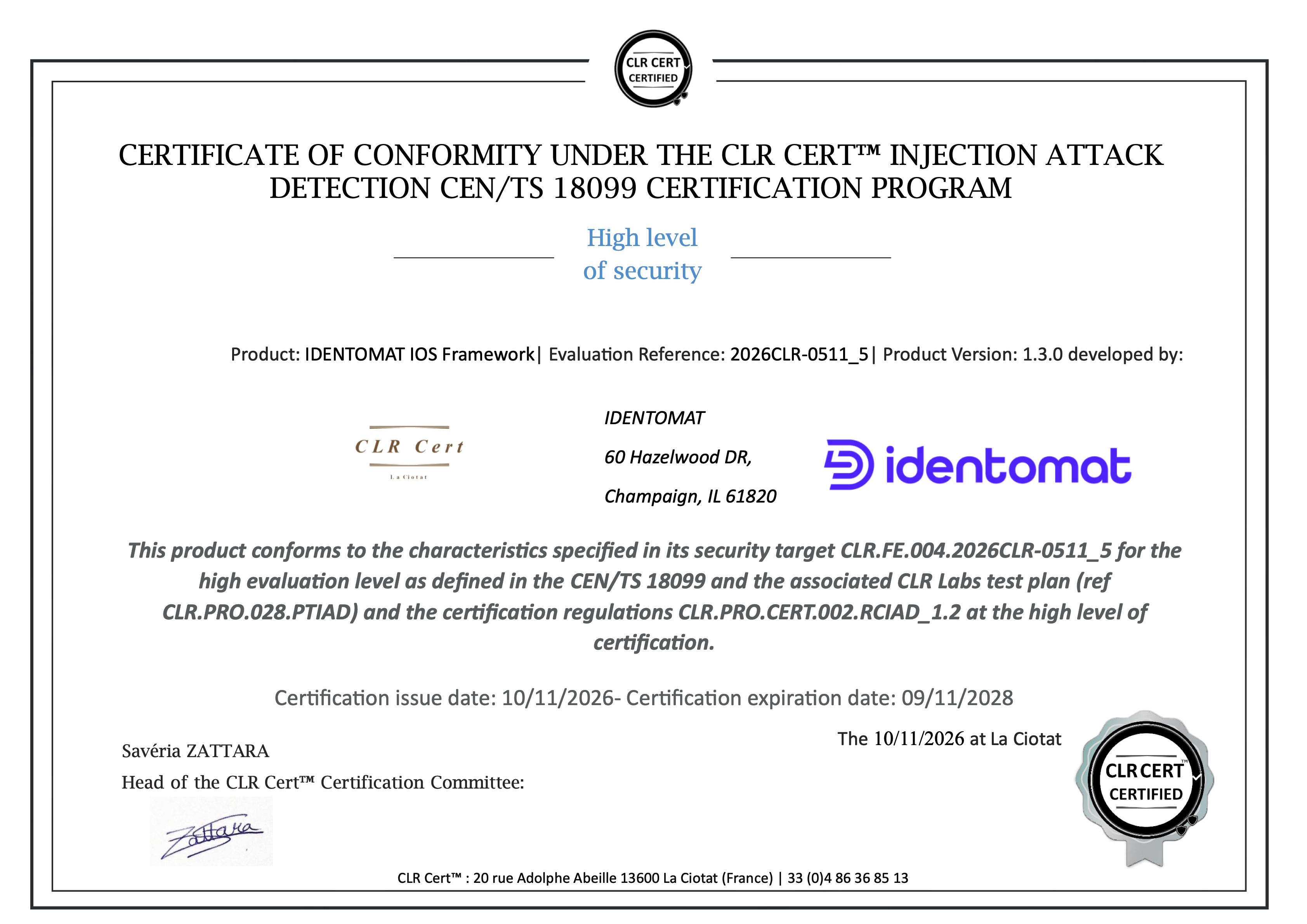
At Identomat, we continue to strengthen our biometric security capabilities, and we are proud to share that our technology has achieved High-level certification for Biometric Injection Attack Detection (IAD) under CEN/TS 18099, following an independent evaluation by CLR Labs under the CLR Cert certification programme.
High is the highest assurance level in the programme, representing an important milestone in our ongoing commitment to strengthening biometric security and protecting digital identity verification processes against increasingly sophisticated attacks.
But what exactly are biometric injection attacks, why are they becoming a growing concern, and what does this certification mean for businesses?
What Are Biometric Injection Attacks?
Biometric injection attacks are attempts to manipulate the biometric verification process by introducing fraudulent or synthetic data directly into the system, bypassing the device’s physical camera capture process.
Unlike conventional presentation attacks, which involve presenting photographs, masks or prerecorded videos in front of a camera, injection attacks target the digital capture pipeline itself.
For example, an attacker might use a virtual camera, a modified application or other technical tools to inject a prerecorded or AI-generated video stream that appears to originate from a legitimate camera.
This creates a different security challenge. Even sophisticated liveness detection mechanisms may be vulnerable if attackers successfully bypass the capture process before biometric data reaches the verification system.
As deepfake technology and digital manipulation tools become more accessible, protecting the integrity of biometric data throughout the verification process is increasingly important.
Presentation Attacks vs. Injection Attacks: What’s the Difference?
Although both techniques aim to deceive biometric verification systems, they exploit different vulnerabilities.
Presentation attacks involve presenting an artificial representation of a person to a biometric sensor. Examples include printed photographs, digital displays showing prerecorded videos, and realistic masks.
Injection attacks, on the other hand, attempt to bypass the sensor or manipulate the data capture process itself. Instead of presenting fraudulent biometric information to a camera, attackers introduce manipulated data directly into the verification workflow.
This distinction highlights why biometric security requires multiple complementary defence mechanisms. Liveness detection and Presentation Attack Detection (PAD) address presentation-based threats, while Injection Attack Detection (IAD) focuses on threats targeting the digital capture process.
What Is CEN/TS 18099?
CEN/TS 18099 is a European technical specification titled Biometric Data Injection Attack Detection, published by the European Committee for Standardization (CEN) in November 2024.
It establishes a common framework for identifying, evaluating and detecting biometric data injection attacks.
The specification addresses different injection attack methods and instruments, provides guidance on detection and mitigation mechanisms, and establishes a methodology for evaluating the effectiveness of injection attack detection systems.
The CLR Cert certification programme applies three assurance levels: Basic, Substantial and High.
High represents the highest certification level within this programme.
Achieving this level requires the evaluated technology to undergo independent assessment against the corresponding testing requirements, providing an additional level of confidence in its ability to detect sophisticated injection attacks.
What Does Identomat’s Certification Mean?
Identomat’s High-level certification under CEN/TS 18099 confirms that Identomat’s technology has undergone independent assessment by CLR Labs under the CLR Cert programme.
This is particularly relevant in an environment where businesses increasingly rely on remote identity verification to onboard customers, establish digital trust and meet regulatory requirements.
For organisations operating in financial services, banking, cryptocurrency, iGaming and other regulated industries, biometric injection attack detection is an important consideration when evaluating the security of digital onboarding processes.
By achieving the highest certification level under CEN/TS 18099, Identomat further demonstrates its focus on addressing emerging threats to biometric verification and strengthening the security of remote identity proofing.
Strengthening Biometric Security Against Both Presentation and Injection Attacks
Effective biometric security requires protection against different types of attacks targeting the verification process. Two particularly important categories are presentation attacks and injection attacks, each exploiting different vulnerabilities.
Identomat’s biometric verification technology has undergone independent testing against both attack categories.
- Presentation Attack Detection (PAD): Identomat’s Liveness Check has achieved iBeta Level 2 testing under ISO/IEC 30107-3, demonstrating its ability to detect sophisticated presentation attacks, including attempts involving physical spoofing instruments.
- Injection Attack Detection (IAD): Identomat has achieved High-level certification under CEN/TS 18099 following independent evaluation by CLR Labs, addressing attacks that attempt to manipulate or replace biometric data within the digital capture process.
Together, these independent evaluations address two distinct aspects of biometric security: detecting fraudulent presentations to a camera and identifying attempts to compromise the biometric capture pipeline.
This complementary approach is particularly important as fraud techniques evolve, requiring identity verification systems to address threats beyond conventional spoofing attempts.
Building More Secure Digital Identity Verification
The achievement also comes at an important time for the European regulatory landscape. As the European Digital Identity (EUDI) Wallet framework advances under eIDAS 2.0 and the EU’s Anti-Money Laundering Regulation (AMLR) approaches its application date of 10 July 2027, the security and reliability of remote identity verification are becoming increasingly important.
By achieving the High assurance level under CEN/TS 18099, Identomat strengthens its capabilities to detect sophisticated biometric injection attacks, supporting organisations in building more secure remote onboarding processes and preparing for evolving European identity verification and AML compliance requirements.
Protecting biometric data means looking beyond the face presented to the camera and ensuring the integrity of the entire capture process.
At Identomat, we continue to develop identity verification technology that addresses evolving fraud techniques while supporting secure and seamless digital onboarding.
Reliable identity verification starts with ensuring that the biometric data being verified is genuine.
Ready to get started?
Empower your platform with Identomat's cutting-edge KYC and AML ID verification.
Book a demo
Frequently asked questions
What is CEN/TS 18099?
CEN/TS 18099 is a European technical specification that establishes requirements and evaluation methods for detecting biometric data injection attacks.
What does High-level certification under CEN/TS 18099 mean?
High is the highest of the three assurance levels defined by the CLR Cert certification programme. It indicates that the evaluated technology has undergone independent assessment against the corresponding testing requirements.
What is the difference between presentation attacks and injection attacks?
Presentation attacks involve using photographs, videos or masks to deceive a camera. Injection attacks attempt to bypass the camera and introduce manipulated or synthetic biometric data directly into the verification process.