For years, video calls have been one of the simplest ways to establish trust remotely.
You see the person. They see you. You have a conversation. You make a decision.
But what happens when the person on the screen isn’t actually the person you think they are?
Generative AI has changed everything, and there is no turning back. Today, a fraudster can use publicly available images, videos, and voice recordings to create increasingly convincing impersonations of executives, customers, business partners, and other trusted individuals. The result is a new identity problem for organizations: a realistic video interaction is no longer necessarily proof of identity.
For businesses operating in regulated or high-value environments, this creates a dangerous blind spot that can cause substantial damage.
And this is precisely where stronger identity verification and risk-based Video KYC can provide an additional layer of assurance, helping organizations avoid potential losses.
The Deepfake CFO Problem Is Already Real
In early 2024, an employee at a multinational company in Hong Kong was targeted in a sophisticated fraud scheme.
The employee received what appeared to be communication from the company’s UK-based Chief Financial Officer and was invited to a confidential video conference. Other participants appeared to be colleagues from the company’s finance department.
They weren’t.
According to Hong Kong police, the video conference had been fabricated using deepfake technology and publicly available video clips and voices. The employee ultimately authorized transfers totaling approximately HK$200 million, equivalent to US$25.5 million, to five local bank accounts. Police later said there had been no genuine interaction with the people appearing in the pre-recorded conference.
The company was subsequently identified as the global engineering firm Arup, which confirmed that fake voices and images had been used in the incident.
The case illustrates a fundamental problem with today’s digital trust model:
Seeing someone on a screen is not the same as verifying their identity.
The FBI has similarly warned that criminals are using AI-generated video and audio to impersonate company executives, authority figures, and other trusted individuals as part of financial fraud schemes.
The lesson isn’t that businesses should stop using video. It is that video should no longer be treated as identity proof by itself.
The new compliance blind spot
Traditional identity controls were designed around a world where the biggest challenge was obtaining enough information to identify someone.
Today, the challenge is increasingly different: How do you know that the person presenting that information is actually the person they claim to be?
Automated KYC has made digital onboarding dramatically faster. Customers can submit an identity document, take a selfie, complete liveness checks, and receive a decision without ever speaking to an employee.
For the majority of straightforward cases, that is exactly what businesses need.
But not every case is straightforward.
A customer may present inconsistent information. A document may require additional review. A high-risk customer may require enhanced due diligence. A legal representative may need to be verified. A transaction may be unusually large. An account recovery request may involve a new device or unusual circumstances. Or, on the other hand, there might be high-risk events happening within the company. C-level executives might want to transfer millions to another account, someone might want to change beneficiary, contact, or bank information, or someone might want to access sensitive data - and that person can, in reality, be someone who is actually authorized to do so, but… that could also be a fraudster using a deepfake to do so.
The reality is that generative AI has become a fraudster’s favorite toy, and if your company doesn’t have good gatekeepers to keep them out, the deepfake CFO problem is not very far away from you either. You need to safeguard your clients and your business with the tools that help you fight this exact problem.
And that tool is Video KYC.
Video KYC as the next layer of identity assurance
Video KYC combines a live interaction with structured identity verification.
Rather than relying on a video conversation alone, the organization can guide the customer through a controlled verification workflow that may include:
- Identity document verification
- Face matching
- Liveness detection
- Additional information or questionnaire steps
- AML screening
- Consent and agreement confirmation
- Human review
- Verification records and audit logs
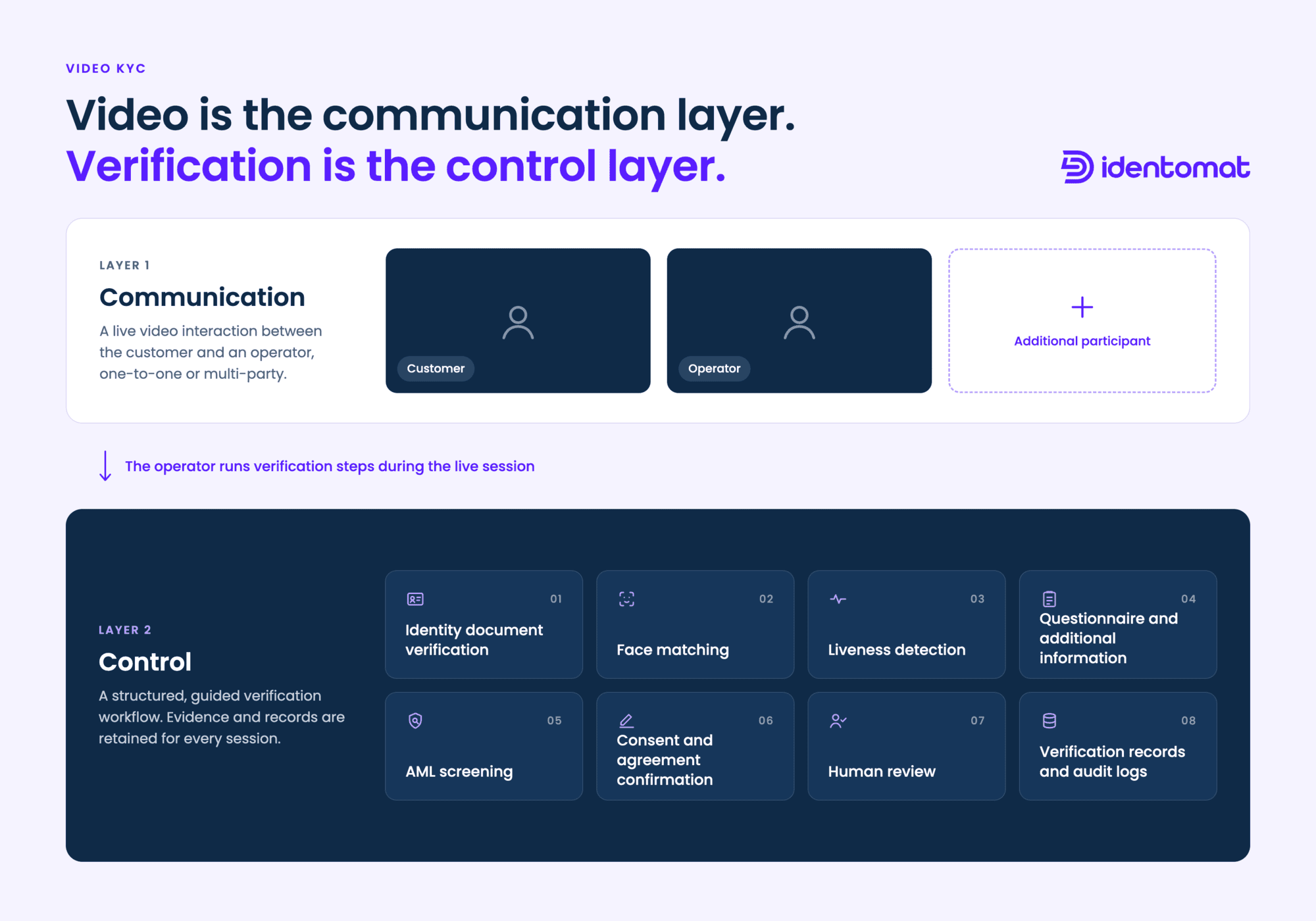
Identomat’s Video KYC supports both one-to-one and multi-party sessions, allowing operators to perform verification steps during the live interaction and retain the resulting evidence and verification records.
This creates an important distinction: Video is the communication layer. Verification is the control layer.
How Video KYC Can Protect High-Risk Actions Within an Organization
Video KYC is a useful tool that goes beyond verifying customers. The deepfake CFO scenario is a good example.
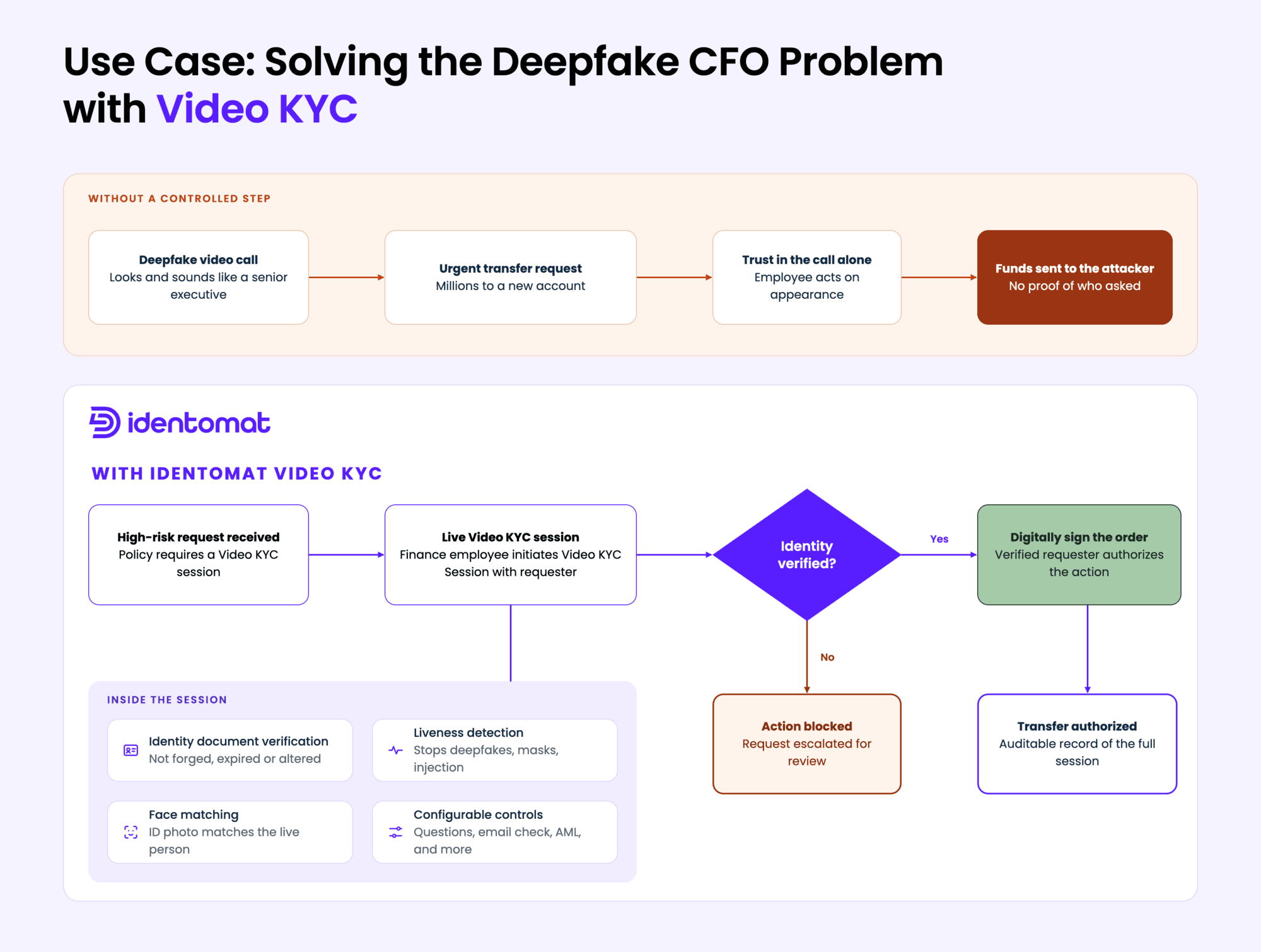
Imagine a finance employee receives a video call from someone who appears to be a senior executive. The executive asks them to urgently transfer millions of dollars to a new account. The face looks right. The voice sounds right. The request appears to come from someone with the authority to make it.
Instead of relying solely on a video call, email, familiar voice, or internal communication channel, an organization could require a controlled verification step for predefined high-risk actions.
The finance employee can initiate a Video KYC session with the individual requesting the high-risk action. During the Video KYC session, the individual can be asked to complete an identity verification workflow that combines live interaction with identity document verification, liveness checks, face matching, and other configurable controls. Once the verification is successfully completed, they could even digitally sign the order authorizing a high-risk action, such as transferring millions of dollars to another account.
During the Video KYC session, the parties can discuss the high-risk event and go through the verification process together. Identity document verification helps ensure that the document is not forged, expired, or otherwise manipulated. The liveness check helps confirm that the person undergoing verification is physically present and live, rather than using a deepfake, mask, or other type of injection or presentation attack. Face matching helps ensure that the person’s ID picture matches the person participating in the verification.
Throughout the Video KYC session, the person undergoing verification can be assisted by an agent or other trained personnel within the company, helping ensure that the entire process is completed as intended. Once the process is successfully completed, the necessary documents can also be approved and digitally signed.
Technically, Video KYC can act as a remote, human-led branch: a controlled environment where you can discuss an event, agree on terms, verify identities, and sign documents - all within one platform. The result is an additional layer of protection against fraud, combined with an auditable record of each session.
And the flow can be customized to fit the specific requirements of your business. Need to add additional questions for the person undergoing verification? You can. Want to add email verification? You can. Need AML screening as part of the process? Yes, that can be included as well, and so much more.
This approach is useful not only for sensitive, high-risk actions within an organization, but also for business-to-business transactions. For example, two companies could use Video KYC when signing a high-value deal, helping verify that the representatives involved are actually the people they claim to be before proceeding.
Video KYC gives organizations the opportunity to conduct sensitive, high-risk actions with customers, employees, company owners, or representatives of other businesses - and much more.
And because the verification flow and user experience can be customized, businesses can build security protocols around their specific risks and requirements while maintaining a more natural, native UX/UI for the people going through the process.
Where Video KYC Can Close the Gap
Video KYC doesn’t need to replace automated KYC. Its value is often as a step-up verification layer for situations where automated checks are inconclusive or the risk is higher.
1. High-risk or complex customer onboarding
Some customers require additional scrutiny due to their risk profile, complex ownership structures, unusual documentation, or inconclusive automated checks. Video KYC allows an operator to verify the customer, clarify outstanding questions, and document the interaction in a single session.
2. High-value financial transactions
Organizations can introduce stronger identity verification before sensitive actions such as large withdrawals, significant account changes, or other high-risk requests. Video KYC can add an identity-assurance layer alongside existing payment controls and independent authorization procedures.
3. Corporate and KYB processes
Businesses need to verify not only their customers, but also the people authorized to represent them. Video KYC can help verify directors, authorized representatives, beneficial owners, and other stakeholders remotely. Multi-participant sessions can also allow several people to be verified in the same session, reducing coordination across locations. Identomat supports multi-participant Video KYC sessions with configurable workflows for each participant.
4. Account recovery and sensitive account changes
Account recovery can create a difficult identity-verification gap: the legitimate customer and an attacker may both be requesting access. When passwords, OTPs, or other automated signals are insufficient, Video KYC can provide an escalation path where an operator guides the customer through identity and liveness checks before access is restored.
5. Lending and high-value financial products
Loan applications, investment accounts, and other high-value financial products may require additional assurance when identity information is inconsistent or documentation is unclear. Video KYC gives digital-first financial providers a way to handle these exceptions remotely without sending customers to a physical branch.
6. Insurance and claims
Insurers can use Video KYC when stronger identity assurance is needed during policy onboarding, complex claims, beneficiary-related processes, or other sensitive requests. Instead of applying the same verification level to every customer, live verification can be reserved for cases that warrant additional scrutiny.
7. Crypto and digital-asset platforms
Crypto platforms combine remote onboarding, cross-border activity, fast-moving transactions, and evolving compliance requirements. A customer may pass initial KYC but later trigger additional risk signals. Video KYC can provide a controlled escalation path for unusual activity, high-value transactions, account recovery, or enhanced due diligence.
8. Government and public services
Government services increasingly rely on remote identity verification for applications, benefits, permits, and other sensitive services. Video KYC can provide an additional verification layer when automated checks are inconclusive, not enough or stronger assurance is required, helping public-sector organizations verify applicants remotely while reducing the need for in-person visits.
Trust Needs a New Layer
The problem with deepfakes isn’t simply that they look convincing. It’s that they exploit something organizations have relied on for years: familiarity.
A familiar face. A familiar voice. A familiar process.
But familiarity is no longer enough to establish identity.
Organizations need to rethink where trust is assumed and where it is actually verified. Not every customer, employee, transaction, or interaction needs the same level of scrutiny. But when the potential consequences are significant, relying on what appears to be real is a risk in itself.
That is where Video KYC can become paramount. Used strategically, it can create a controlled point of verification around the moments where identity matters most.
Want to avoid fraudsters? The Identomat team is always happy to demonstrate our solutions in action. Book a meeting.
Ready to get started?
Empower your platform with Identomat's cutting-edge KYC and AML ID verification.
Book a demo
Frequently asked questions
What is Video KYC?
Video KYC is a remote identity verification process that combines a live video interaction with structured verification controls such as identity document verification, face matching, liveness detection, questionnaires, AML screening, and human review. It provides an additional layer of identity assurance when automated KYC alone may not be sufficient.
Can Video KYC prevent deepfake fraud?
Video KYC can help organizations reduce the risk of deepfake-based impersonation by combining a live interaction with identity verification and liveness controls. A video call on its own does not prove someone’s identity, but Video KYC - a controlled verification workflow can provide stronger evidence that the person participating in the session is the legitimate identity holder.
How does Video KYC help protect against deepfake impersonation?
Video KYC can combine live interaction with identity document verification, face matching, liveness detection, and other configurable controls. This creates a more controlled verification environment than relying on a video call, email, voice, or familiar communication channel alone.