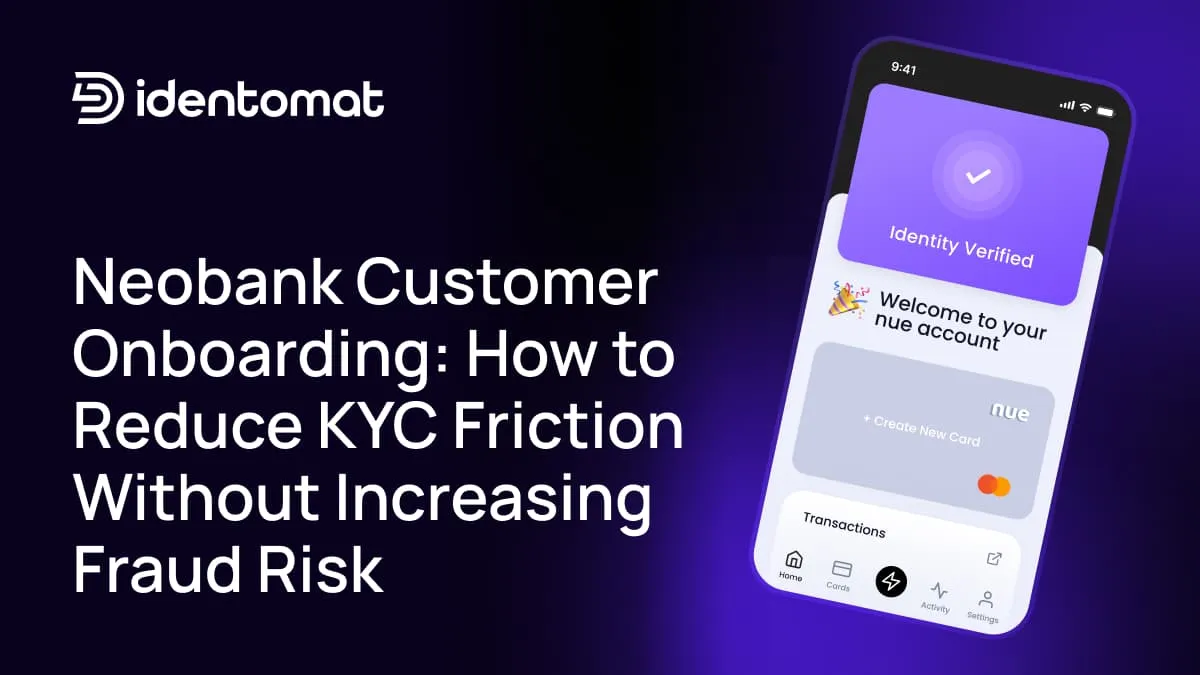

Neobanks compete on speed and convenience. Customers expect to open an account from their phone without visiting a branch, completing lengthy forms, or waiting days for approval.
That expectation creates a difficult challenge. A neobank must make onboarding easy for legitimate customers while protecting itself from forged documents, stolen identities, synthetic identities, mule accounts, sanctions exposure, and other financial crime risks.
The answer is not to remove identity and compliance checks. It is to apply them more intelligently. A well-designed onboarding process moves straightforward applications through quickly while adding verification only when the customer, transaction, product, or risk signals justify it.
What does neobank customer onboarding include?
Neobank customer onboarding is the process of turning an applicant into a verified and active digital banking customer.
It usually begins with account registration and basic information collection. The neobank then verifies the applicant’s identity, checks the customer against sanctions and politically exposed person lists, assigns an initial risk level, and decides whether the account can be approved automatically or needs further review.
The process should not end when an identity document passes verification. A valid document does not necessarily prove that the person presenting it is the document holder, that the identity is not being misused, or that the customer presents an acceptable risk.
For that reason, remote onboarding often combines document verification, face matching, liveness detection, AML screening, customer due diligence, and risk assessment.
The European Banking Authority’s remote onboarding guidelines require financial institutions to implement and monitor safe and effective remote customer onboarding processes within their wider AML and CTF control environment.
Why neobank onboarding creates friction
Some friction is unavoidable. Customers may need to upload an identity document, complete a liveness check, or answer questions required by the neobank’s compliance policy.
However, much of the frustration associated with KYC does not come directly from regulation. It comes from poor workflow design.
A common problem is asking every customer for the same information at the same time. A low-risk applicant with a supported document and consistent information may be sent through the same process as someone with conflicting data, an unusual device profile, or a high-risk geographic connection.
This creates unnecessary work for legitimate users and may still fail to apply enough scrutiny to higher-risk cases.
Document capture is another major source of abandonment. Customers may upload images with glare, blur, cropped edges, poor lighting, or unsupported document types. When the system responds only with “verification failed,” the customer does not know how to correct the problem.
Repeated data entry also creates avoidable friction. When information has already been extracted from an identity document, applicants should typically review and confirm it rather than enter the same details multiple times.
Manual review can create further delays. If analysts receive incomplete cases or need to search across several systems for documents, screening results, and triggered rules, straightforward applications may remain unresolved for hours or days.
Removing checks is not the solution
Reducing friction should not mean reducing identity assurance.
A shorter onboarding process may improve completion rates in the short term, but weak controls can increase exposure to document fraud, account farming, identity theft, sanctions breaches, and mule-account activity.
The UK Financial Conduct Authority has repeatedly warned that rapid customer growth can outpace financial crime controls. Its review of challenger banks identified weaknesses in customer risk assessments, customer information collection, enhanced due diligence, and transaction monitoring.
In 2025, the FCA also fined Monzo more than £21 million for earlier weaknesses in its financial crime systems and controls. The case illustrated that onboarding growth, risk management, and operational capacity need to scale together.
Neobanks should therefore remove unnecessary steps while preserving the controls needed to establish identity and assess risk.
Use risk-based onboarding instead of one fixed journey
Risk-based onboarding allows a neobank to apply different verification paths to different applicants.
A low-risk applicant may be able to complete document verification, face matching, liveness, and AML screening without human intervention. An applicant with incomplete or inconsistent information may need an address check or additional questionnaire. A high-risk case may need enhanced due diligence, video verification, or manual review.
These paths should be based on the neobank’s products, customers, markets, regulatory obligations, and risk appetite.
The principle is simple: start with the lowest-friction set of checks that provides sufficient confidence, then introduce additional verification when policy or risk requires it.
How to reduce KYC friction without weakening controls
The onboarding experience should begin before the applicant uploads a document. Customers should know what they need, which documents are accepted, why identity verification is required, and what happens if an automated check is unsuccessful.
Clear expectations reduce confusion and prevent customers from reaching the verification stage unprepared.
During document capture, the system should identify quality problems in real time. Instead of displaying a generic error, it should explain whether the image is blurred, the document is cropped, the lighting is poor, or a different document is required.
Optical character recognition can then extract information from the document and prefill relevant fields. The applicant can confirm or correct the information rather than entering everything manually.
Biometric instructions should also be specific and easy to follow. Customers should understand whether they need to move closer to the camera, improve the lighting, remove an obstruction, or repeat a movement.
Additional checks should be conditional. Proof of address, enhanced questionnaires, source-of-funds information, or video verification should usually appear because a rule, regulation, or risk signal requires them, not because they have been added to every journey by default.
Neobanks should also provide secure fallback routes. A legitimate applicant may have an unsupported document, an older device, accessibility needs, or an inconclusive automated result. An alternative document, assisted review, or video KYC process can prevent these users from being rejected automatically.
Preventing fraud during onboarding
No single identity check can address every form of account-opening fraud.
Document authentication helps identify altered, expired, or forged documents. Face matching checks whether the person resembles the portrait in the document. Liveness detection helps distinguish a real person from a photograph, replay, or presentation attack.
Neobanks may also use device, behavioral, and duplicate-account signals to identify suspicious application patterns. These controls can reveal emulators, automated submissions, repeated use of the same identity, or connections between apparently separate applicants.
AML screening adds another layer by identifying sanctions, PEP, watchlist, and adverse-media risks.
These signals should be evaluated together. A document may appear valid while the device, face, customer information, or application behavior presents material concerns.
The goal is not to add as many checks as possible. It is to combine independent controls that address different risks and route the application appropriately.
Manual review should be an exception process
Manual review is necessary when an automated system cannot resolve a case confidently. It should not become the default route for large numbers of ordinary applicants.
Analysts need a complete view of the case, including the applicant’s information, document results, biometric checks, AML alerts, triggered rules, previous decisions, and the reason for escalation.
Cases should also be prioritized by risk. A potential sanctions match should not sit in the same queue as a minor document-quality issue.
Review outcomes should feed back into the automated process. If analysts repeatedly approve the same type of false positive, the neobank may need to adjust its matching logic or escalation thresholds. If fraud repeatedly appears in applications that passed automatically, additional controls may be needed.
Which onboarding metrics matter?
Completion rate is important, but it should not be measured in isolation.
A neobank should track where applicants abandon the process, how many complete verification on the first attempt, how long decisions take, and how frequently documents need to be recaptured.
These experience metrics should be reviewed alongside fraud and compliance outcomes. Relevant measures include confirmed onboarding fraud, sanctions alerts, false-positive rates, duplicate-account detections, enhanced due diligence rates, and fraud discovered after approval.
Operational measures also matter. Neobanks should monitor the percentage of applications approved automatically, the manual-review rate, average review time, analyst workload, and cost per approved customer.
A higher completion rate is not a meaningful improvement if fraud losses, regulatory exceptions, or manual-review costs increase at the same time.
Onboarding continues after account approval
A customer may present a low risk during account opening and a different risk after beginning to use the account.
Sanctions status can change. Personal information may become outdated. Transaction activity may differ from the expected account purpose. Dormant accounts may suddenly become active, or a legitimate account may be taken over.
The initial onboarding profile should therefore connect to ongoing KYC, AML screening, and transaction monitoring.
This allows the neobank to review customers when relevant information or behavior changes rather than relying only on the original account-opening decision.
How Identomat supports neobank customer onboarding
Identomat helps neobanks combine identity verification, fraud controls, and compliance checks within configurable onboarding workflows.
The platform supports document verification and data extraction, biometric face matching, liveness detection, AML screening, customer information collection, configurable risk rules, step-up verification, manual review, and audit records.
Identomat’s configurable workflows, white-label design, and easy integration help businesses deploy quickly and create onboarding experiences that fit seamlessly into their platforms, feel native and intuitive to users, and support compliance with regulatory requirements.
Build a faster, risk-based onboarding journey
Effective neobank onboarding does not remove controls. It applies the right controls to the right customer at the right time.
Legitimate applicants should be able to complete verification without unnecessary repetition or delays. Higher-risk and inconclusive cases should receive structured additional checks and review.
Identomat helps neobanks connect identity verification, biometrics, AML screening, risk rules, manual review, and audit evidence within one configurable environment.
Ready to get started?
Empower your platform with Identomat's cutting-edge KYC and AML ID verification.
Book a demo
Frequently asked questions
What is neobank customer onboarding?
Neobank customer onboarding is the remote process of registering an applicant, verifying their identity, conducting customer due diligence, assessing risk, approving the account, and beginning ongoing monitoring.
Why do customers abandon neobank KYC?
Common causes include unclear instructions, document-capture failures, repeated data entry, unsupported documents, unnecessary verification steps, generic error messages, and slow manual review.
How does Identomat support neobank onboarding?
Identomat supports configurable onboarding workflows that combine document verification, biometrics, liveness, AML screening, risk rules, step-up verification, manual review, and audit records.