
False positives are not a small AML inconvenience. They are an operating cost.
Every weak alert takes time. An analyst has to open the case, check the customer profile, compare identity details, review the match, document the decision, and decide whether the case should be cleared or escalated. When most alerts lead nowhere, compliance teams lose hours on low-value work while real risk becomes harder to spot.
The answer is not to screen less. The answer is to screen with better context.
AML false positives often happen because screening systems are asked to make decisions with incomplete or poorly structured data. A name alone is rarely enough. Similar names, missing dates of birth, inconsistent addresses, weak onboarding records, and disconnected systems all make screening noisier than it needs to be.
Reducing AML false positives without increasing risk requires a more connected approach. Identity verification, onboarding KYC, AML screening, risk scoring, and case review should work together inside one flow, so every alert is supported by stronger data and clearer context.
Why AML False Positives Happen
False positives usually begin with weak context.
A name-only match can create noise very quickly. If a customer shares a similar name with a sanctioned person, politically exposed person, or adverse media subject, the system may generate an alert even when the underlying risk is low.
The problem becomes harder when the customer record is incomplete. Missing dates of birth, unverified addresses, inconsistent name spelling, poor document data, and weak identity checks all make it harder to separate a real match from a lookalike.
For example, a customer may trigger a sanctions or adverse media alert because their name is similar to a listed individual. If the system only has the customer’s name, the analyst has to investigate from scratch. But if the case already includes verified date of birth, nationality, document data, address, onboarding history, and other risk signals, the alert becomes much easier to assess.
That is why AML screening should not begin with whatever a user typed into a form. It should begin with a verified identity record.
Better Identity Data Creates Better AML Screening Results
A more effective AML process starts before the first watchlist check.
Before screening begins, businesses should be able to verify the customer’s identity, extract reliable data from their document, check for fraud signals, confirm liveness, and structure the customer profile properly. Cleaner identity data gives the AML screening system better inputs.
Better inputs lead to better decisions.
When AML screening relies only on a name, it has very little to work with. When it can also use verified date of birth, nationality, document information, address, and other identity attributes, the system can separate weak lookalike matches from more meaningful risk signals.
This also helps analysts work faster. A reviewer should not have to fix weak onboarding data during alert resolution. The case should already include the information needed to understand whether the alert is relevant.
In other words, identity verification does not only protect onboarding from fraud. It also helps reduce AML screening noise.
Configurable Match Scoring Helps Reduce Unnecessary Alerts
False-positive reduction depends heavily on how matches are scored.
A rigid screening setup can create too many alerts because it treats weak similarities as serious matches. A more flexible AML system should allow businesses to configure match thresholds.
This matters because not every business, customer segment, or jurisdiction carries the same level of risk.
A lower-risk customer segment may justify one screening threshold. A higher-risk customer segment may require stricter rules. A business operating across multiple markets may need different policies depending on geography, product type, transaction behavior, or regulatory expectations.
Configurable match scoring gives compliance teams more control. Instead of forcing every user through the same screening logic, teams can decide what should qualify as a serious alert and what can be treated as a weak match.
A strong AML setup should also consider mismatched attributes. A similar name should not automatically carry the same weight if the date of birth, nationality, address, or identification number clearly does not match. Penalizing mismatched attributes helps reduce unnecessary alerts while keeping meaningful matches visible.
Disconnected KYC and AML Systems Make False Positives More Expensive
The alert itself is only part of the cost.
The bigger cost often comes from everything around it: switching between systems, rebuilding context, checking data manually, waiting for missing information, and documenting the same decision across multiple tools.
A disconnected compliance stack makes every false positive slower to resolve.
If identity verification happens in one system, AML screening happens in another, risk scoring happens somewhere else, and case review is handled manually, analysts lose time before the actual investigation even begins. Fragmented systems create duplicated work, slower decisions, and weaker case context.
A connected workflow solves a practical problem. Identity results, AML screening outcomes, risk signals, and case history stay in one place. Analysts can understand the customer faster, clear weak alerts more confidently, and escalate serious cases with better evidence.
False positives may still happen. But in a connected system, they become easier to investigate and faster to close.
API-First AML Workflows Reduce Manual Review Drag
Reducing false positives is not only a screening problem. It is also a workflow problem.
Even a well-tuned AML screening system can create operational drag if results are handled manually. Compliance teams need structured responses, real-time status updates, automated case routing, and clear review paths.
An API-first AML workflow helps internal systems receive screening results, update customer status, route cases, trigger reviews, and keep records without relying on manual status chasing.
This reduces wasted time in two ways.
First, the system sends better identity and screening context into the case. Second, the workflow reduces the operational friction around each review.
Fewer clicks do not solve compliance. Better case architecture does.
Ongoing AML Monitoring Needs the Same Discipline
Initial screening is not the whole AML story.
A customer can look clean during onboarding and become higher-risk later. New sanctions can be issued. A person can become politically exposed. Negative media can appear after the customer has already joined the platform. Transaction behavior can change over time.
That is why AML monitoring should not stop after onboarding.
However, ongoing monitoring can also create noise if it is not properly configured. The same principles apply: clean identity data, configurable matching, broader risk context, and connected case handling.
What to Look for in AML Screening Software
A good AML screening system should do more than run a basic watchlist check.
Businesses that want to reduce false positives without increasing compliance risk should look for AML software provider that supports:
- Identity verification before screening
- Configurable match thresholds
- Sanctions, PEP, watchlist, and adverse media screening
- Integrated KYC, Liveness Check, Age Verification, and other solutions
- API-based orchestration
- Centralized case review
- Ongoing AML monitoring after onboarding
False positives cannot be solved with one setting alone. Compliance teams need better data, better matching logic, and better workflow design.
How Identomat Helps Reduce AML False Positives
Identomat helps businesses reduce AML false positives by connecting Identity Verification, Onboarding KYC, AML Monitoring, Risk Assessment, and case review inside one workflow.
Instead of screening users based only on basic form data, Identomat helps teams build stronger identity records before AML screening begins. Verified identity data can then be used together with configurable screening parameters, match score thresholds and ongoing monitoring workflows.
This gives compliance teams more control over how alerts are generated, reviewed, and prioritized. A weak name match does not have to be treated the same way as a high-confidence match supported by multiple risk signals.
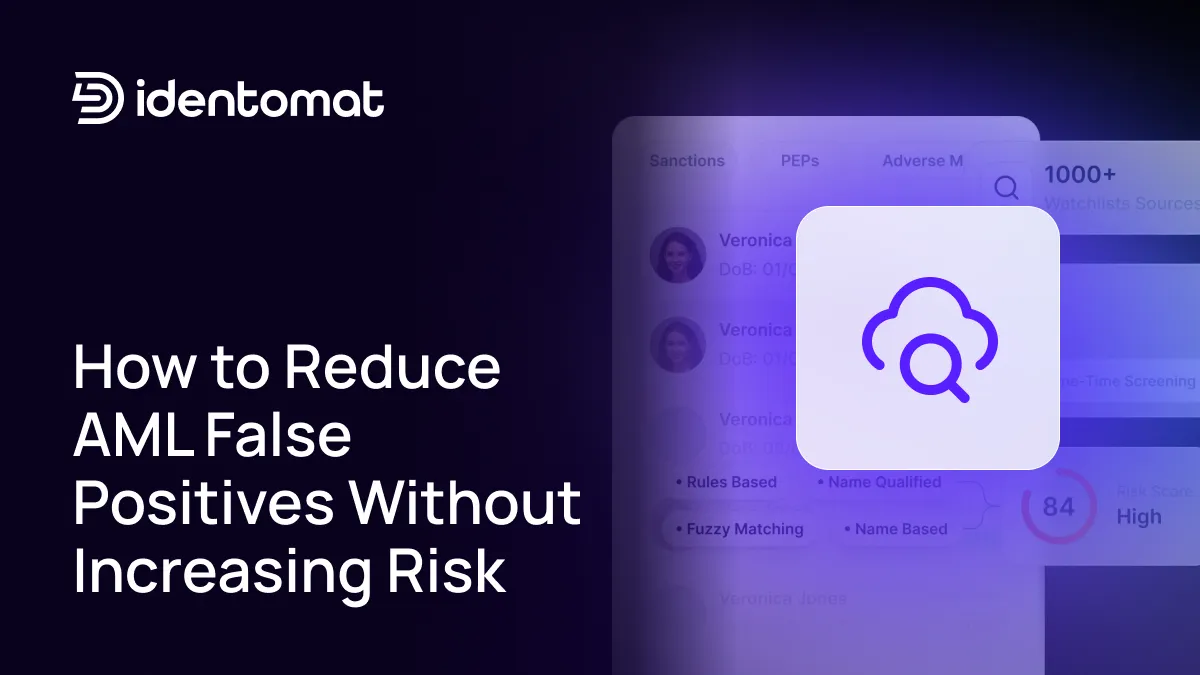
With Identomat, businesses can combine identity verification, sanctions and PEP screening, adverse media checks, customizable AML parameters, risk scoring, and monitoring in a more connected compliance flow.
For analysts, this means better case context.
For product teams, it means a smoother onboarding process.
For compliance leaders, it means fewer weak alerts, faster reviews, and stronger confidence in the cases that actually deserve attention.
Ready to get started?
Empower your platform with Identomat's cutting-edge KYC and AML ID verification.
Book a demo
Frequently asked questions
What is "Fuzzy Matching" and how does it impact false positive rates?
Fuzzy matching is a search technique used by AML systems to identify strings that match approximately rather than exactly. This allows the system to catch bad actors who intentionally misspell names, use aliases, or swap the order of their first and last names (e.g., matching "Jon Smith" with "John Smith"). While fuzzy matching is vital for catching evasion tactics, setting the threshold too low causes an explosion of false positives. Best-in-class platforms allow teams to dynamically adjust these percentages based on user risk tiers.
How do "Secondary Identifiers" prevent lookalike name alerts?
When an AML system screens a common name, it will naturally generate lookalike hits. Secondary Identifiers are additional data points—such as exact date of birth, nationality, country of residence, or national ID numbers—used to filter these matches. By automatically cross-referencing the customer’s verified identity data against the background watchlist entry, the system can immediately discard a lookalike alert if the birth year or nationality fails to match, preventing the case from ever hitting an analyst's desk.
Can AI automatically resolve clear false positives without human intervention?
Yes, this process is known as Automated Triage. While high-confidence matches must always be reviewed by a compliance officer, advanced AML orchestration tools can use automated rule engines to instantly close out obvious false positives. For example, if a name triggers a partial match on a sanctions list, but the system verifies that the listed individual has been deceased for fifty years or is of a completely different gender than the applicant, the AI can log the audit trail and auto-clear the alert.