
Fintech onboarding is no longer limited to verifying individual customers. Payment gateways, SME neobanks, embedded finance platforms, marketplaces, lending platforms, and B2B wallets all need to onboard companies quickly, safely, and at scale.
That is where the challenge begins.
A consumer KYC flow usually verifies one person. Business onboarding has to verify a legal entity, its registration details, its operating activity, its representatives, its ownership structure, and the individuals who ultimately own or control it. For fintechs, this can quickly turn into a manual process built around registry searches, document requests, spreadsheets, ownership charts, and repeated compliance review.
Fintech KYB software solves this by turning business verification, Ultimate Beneficial Owner identification, AML screening, and risk-based decisioning into one structured workflow. The goal is simple: approve legitimate businesses faster while giving compliance teams the evidence and control they need for B2B KYC compliance.
Why Consumer KYC Tools Are Not Enough for Business Onboarding
Consumer KYC answers a direct question: is this person who they claim to be?
KYB asks a broader set of questions:
- Does this business legally exist?
- Is the business active, dissolved, suspended, or newly incorporated?
- Is the applicant authorized to act on behalf of the company?
- Who owns or controls the business?
- Are any directors, representatives, owners, or related entities exposed to sanctions, PEP, or adverse media risk?
- Should the company go through standard due diligence or enhanced due diligence?
This is why consumer KYC tools often fall short for business onboarding. They may verify the person completing the application, but they do not fully resolve the business behind that person.
For fintechs, that creates risk. A payment platform may approve a merchant before understanding its real ownership. A neobank may open an SME account without validating the control structure. An embedded finance provider may collect company documents but still lack a consistent risk profile.
Many regulatory frameworks require verification during business onboarding, but the specific requirements for fintech companies can vary by country, sector, and customer type.
For example, for U.S.-covered financial institutions, FinCEN’s Customer Due Diligence rule requires policies and procedures to identify and verify customers, identify and verify the beneficial owners of legal entity customers, understand the nature and purpose of customer relationships, and conduct ongoing monitoring on a risk-based basis.
The Operational Cost of Manual KYB
Manual KYB is expensive because it spreads one decision across too many disconnected steps.
A compliance analyst may need to review company documents, search registry data, compare names and registration numbers, request shareholder information, map ownership, verify representatives, screen entities and individuals, then document the reasoning behind each approval or rejection.
That process becomes harder when fintechs onboard many business types at once: local SMEs, cross-border merchants, marketplace sellers, agents, suppliers, contractors, lenders, or platform partners.
Manual review creates four major problems:
Slower time to approval: Legitimate businesses wait longer while teams chase missing documents or verify ownership manually.
Inconsistent decisions: Two analysts may interpret the same corporate structure differently.
More applicant back-and-forth: Missing fields, unclear documents, and incomplete ownership data create email loops.
Weaker scalability: Business onboarding volume can grow faster than compliance headcount.
Liminal’s 2025 KYC research found that 98% of practitioners automate at least some KYC tasks, with automation helping speed reviews, decisions, and onboarding. The same research found that accuracy, data quality, regulatory compliance, and scalability are the top buying criteria for KYC solutions.
For fintech KYB software, those same priorities matter. A business onboarding workflow needs to be accurate, structured, scalable, and easy to audit.
Why UBO Mapping Slows Business Onboarding
Ultimate Beneficial Owner mapping is often the hardest part of KYB.
A simple company may have two founders, each owning 50 percent. A more complex company may include holding companies, foreign entities, nominee arrangements, trusts, minority shareholders, or several layers of legal persons.
The operational challenge is to move from business records to real people. Fintechs need to understand who owns the company directly, who owns it indirectly, and who controls the company even if they do not hold the largest ownership share.
FinCEN’s CDD rule refers to identifying and verifying any individual who owns 25 percent or more of a legal entity and one individual who controls the legal entity. Requirements differ by jurisdiction and institution type, so fintechs should align thresholds with their own regulatory obligations and risk policy.
FATF also emphasizes that beneficial ownership information should be adequate, accurate, and up to date. Its guidance on legal persons explains that countries using a multi-pronged approach, combining information from companies, registries, public authorities, or alternative mechanisms, have been more effective than those relying on a single approach.
That is why automated business onboarding should not rely on one document or one data source. It should combine company information, registry checks, ownership declarations, representative verification, UBO data, and AML screening into a single workflow.
How Automated Business Onboarding Works
Automated business onboarding replaces scattered manual tasks with a structured KYB process.
Instead of collecting documents through email and reviewing them across separate tools, a fintech can guide each applicant through a digital flow that collects the right data, validates it, screens relevant parties, and routes the case based on risk.
A strong automated KYB workflow usually includes the following layers.
1. Company Data Collection
The first step is to collect the company’s formal profile. This usually includes legal name, registration number, registered address, trading name, website, jurisdiction, business type, and contact details.
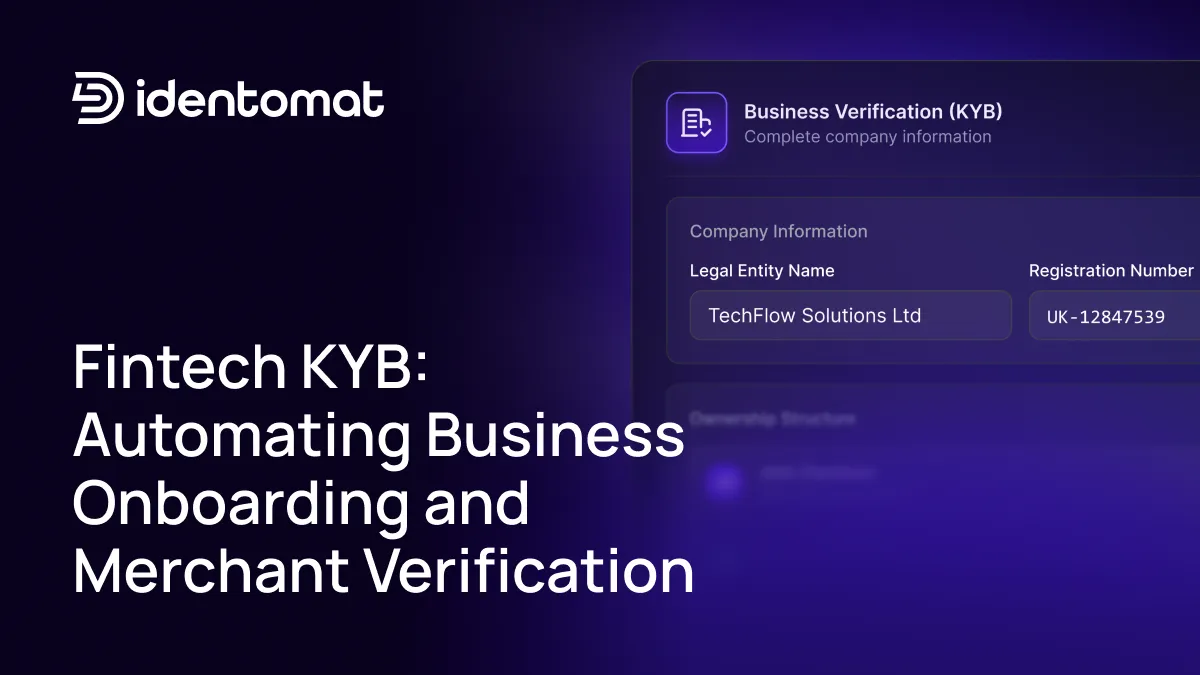
Identomat’s KYB workflow supports structured collection of company information, management and representative details, beneficiaries and stakeholders, and business activity information. This includes company name, registration number, legal address, website, management roles, ownership percentages, products or services, and expected monthly turnover where required.
Structured intake matters because it reduces missing fields and makes cases easier to review. Instead of receiving unstructured documents and free-text explanations, compliance teams receive standardized data they can verify, export, and audit.
2. Business Verification
After collection, the fintech needs to verify that the business is legitimate.
This can include checking whether the company exists, whether the registration number is valid, whether the company name and address match available records, and whether the entity status creates risk.
Identomat’s KYB solution supports both data collection and data collection plus verification. The verification model cross-references business information against reliable sources, helping teams apply a more consistent KYB standard across countries and customer segments.
For fintechs, this is especially important when onboarding businesses across multiple jurisdictions. Registry access, naming conventions, document types, and company identifiers vary by market. The KYB workflow needs to normalize those differences into a consistent review process.
3. UBO and Ownership Capture
Once the business is identified, the next step is to understand ownership and control.
A KYB workflow should capture significant owners and stakeholders, including natural persons and legal persons. It should also support ownership percentages, identification numbers, and multiple beneficiaries where needed.
Identomat’s KYB flow is designed to collect beneficiary and stakeholder information across people and entities, including identification numbers and ownership or share percentages where applicable.
This helps fintech compliance teams move away from static PDF ownership charts and toward structured ownership data. That data can then trigger individual KYC, AML screening, enhanced due diligence, or manual review based on policy.
4. Representative and Stakeholder KYC
Business onboarding is not only about the company. It is also about the people connected to the company.
A fintech may need to verify:
- The person submitting the application
- Authorized representatives
- Directors or managers
- UBOs
- Controlling persons
- Signatories
- High-risk stakeholders
This is where KYB and KYC work together. The legal entity is verified through KYB, while relevant individuals are verified through KYC. For B2B KYC compliance, the workflow should be able to trigger individual checks only when they are needed, rather than forcing every business through the same path.
Identomat’s KYB product supports triggering individual stakeholder KYC when needed within the same no-code workflow. Identomat’s solutions also include Liveness Check and Face Match to help ensure that representatives and stakeholders are really present, prevent spoofing, deepfake, video replay attacks, and other fraud attempts, and confirm that they match the government-issued ID they provide during the KYC process.
5. AML Screening
KYB is incomplete without AML screening.
A fintech should screen the company and relevant individuals against sanctions, PEP, adverse media, and watchlist data. This is important for payment platforms, SME banking, embedded finance, lending, crypto-adjacent services, marketplaces, and cross-border merchant onboarding.
Identomat’s AML Monitoring screens individuals and companies against sanctions, PEP, adverse media, and watchlists. It supports configurable thresholds, automated screening and re-screening, case review, and ongoing monitoring inside the onboarding flow.
This matters because business risk changes. A company may pass initial checks, then later trigger risk through ownership changes, sanctions exposure, adverse media, or transaction behavior. KYB should not be treated as a one-time form. It should support ongoing monitoring after approval.
6. Risk-Based Review and Decisioning
Not every business requires the same level of review.
A low-risk local SME may need a simple KYB path. A cross-border merchant, high-risk industry, complex ownership chain, or unusually high expected turnover may require deeper checks.
The European Banking Authority’s remote onboarding guidelines set out steps financial institutions should take to ensure safe and effective remote onboarding practices in line with AML/CFT legislation and the EU data protection framework. The EBA also describes these guidelines as risk-sensitive and technologically neutral.
For fintechs, the practical takeaway is clear: KYB workflows should adapt to risk. They should allow teams to approve low-risk businesses quickly, route unclear cases to review, and apply enhanced due diligence where the facts require it.
Merchant Verification in Fintech: Why KYB Matters for Payments
Merchant verification fintech workflows have a specific risk profile.
A payment gateway or embedded payments provider needs to know whether a merchant is real, what it sells, who controls it, and whether its expected activity fits the platform’s risk policy.
Weak merchant onboarding can expose fintechs to fake businesses, shell entities, prohibited activity, transaction laundering, hidden beneficial owners, fraudulent payouts, and elevated chargeback risk.
A strong merchant verification workflow should collect and verify:
- Legal business name
- Registration number
- Registered and operating address
- Business website
- Industry and product category
- Expected transaction volume
- Ownership and control structure
- Authorized representative details
- UBO information
- Sanctions, PEP, and adverse media screening results
- Risk decision and audit trail
This gives payment teams a clearer view before activating merchant accounts. It also gives risk teams a stronger baseline for post-onboarding monitoring.
What Fintech KYB Software Should Include
A reliable fintech KYB software platform should support the full business onboarding journey, not only document upload.
Important capabilities include:
- Structured business data collection
- Registry and trusted-source verification
- UBO identification and ownership capture
- Representative and director verification
- Individual KYC for UBOs and authorized persons
- AML screening for companies and individuals
- Sanctions, PEP, adverse media, and watchlist checks
- Configurable risk-based workflows
- Manual review and case management
- Ongoing monitoring
- API and no-code workflow options
- Audit trails and traceable decisions
- Support for multiple jurisdictions
- White-label onboarding experience
Identomat’s KYB solution includes no-code workflow configuration, automated business verification, risk assessment, global coverage, customizable workflows, regulatory compliance support, and structured record keeping for traceable decisions.
The strongest KYB software should help fintechs answer three questions consistently:
- Is this business real?
- Who owns or controls it?
- Does the risk profile match our onboarding policy?
How KYB Automation Improves B2B KYC Compliance
KYB automation is valuable because it standardizes decisions.
Manual teams can still review higher-risk cases, but the workflow should collect data consistently, trigger checks automatically, and preserve a clear decision history. This helps fintechs reduce avoidable manual work without removing compliance oversight.
Automation improves B2B KYC compliance in several ways:
Cleaner intake: Guided forms reduce missing data and incomplete applications.
Faster reviews: Teams spend less time collecting documents and more time evaluating risk.
More consistent UBO mapping: Ownership data is captured in a structured format.
Better screening coverage: Entities and individuals can be screened in one process.
Risk-based escalation: Higher-risk businesses can be routed to enhanced review.
Stronger audit trails: Decisions, data, and case actions are easier to document.
Scalable operations: Onboarding can grow without requiring the same linear increase in manual review work.
Liminal’s KYC report also highlights integration as a strategic requirement, noting that connectivity between compliance, fraud detection, and onboarding systems helps create a more unified approach to risk management and reduces data silos.
For fintechs, this is a major point. KYB data should not sit in an isolated compliance folder. It should inform onboarding, product eligibility, transaction monitoring, risk scoring, account reviews, and ongoing lifecycle management.
How Identomat Supports Automated Business Onboarding
Identomat helps fintechs build KYB workflows that match their internal process, market requirements, and risk policy.
With Identomat KYB, teams can collect company information, verify business details, capture management and representative information, map beneficiaries and stakeholders, trigger individual KYC when needed, and route cases through review and decisioning. The platform also supports ongoing monitoring for continuous compliance.
For fintech business onboarding, this creates a single flow for:
- Entity verification
- Ownership data collection
- UBO identification
- Representative verification
- AML screening
- Risk-based review
- Ongoing monitoring
- Audit-friendly records
Identomat’s AML Monitoring can be embedded into the same onboarding process, allowing companies and individuals to be screened, scored, reviewed, and monitored through configurable workflows.
This helps fintechs move from manual paperwork to a scalable KYB process that supports both growth and compliance.
Conclusion
Business onboarding is more complex than individual onboarding. Companies have ownership structures, representatives, registration details, operating profiles, and financial crime risks that consumer KYC tools do not fully resolve.
For fintechs, the cost of manual KYB is not only slower approvals. It is inconsistent decisions, fragmented data, limited scalability, and weaker visibility into business risk.
Fintech KYB software turns that process into a structured workflow. By combining automated business onboarding, merchant verification, UBO mapping, AML screening, and risk-based decisioning, fintechs can onboard legitimate companies faster while maintaining stronger B2B KYC compliance.
For payment gateways, SME neobanks, embedded finance platforms, marketplaces, and B2B financial products, KYB is no longer just a compliance requirement. It is part of the infrastructure needed to scale safely.
Ready to get started?
Empower your platform with Identomat's cutting-edge KYC and AML ID verification.
Book a demo
Frequently asked questions
What is fintech KYB software?
Fintech KYB software is a business verification solution that helps fintech companies onboard legal entities. It can collect company data, verify registration details, identify owners and representatives, run AML screening, and support ongoing monitoring.
How is KYB different from KYC?
KYC verifies an individual customer. KYB verifies a business entity and the people behind it, including representatives, directors, shareholders, controlling persons, and Ultimate Beneficial Owners.
What is automated business onboarding?
Automated business onboarding is the use of digital workflows, business data collection, registry checks, UBO mapping, stakeholder KYC, AML screening, and risk-based decisioning to approve or review business customers with less manual paperwork.