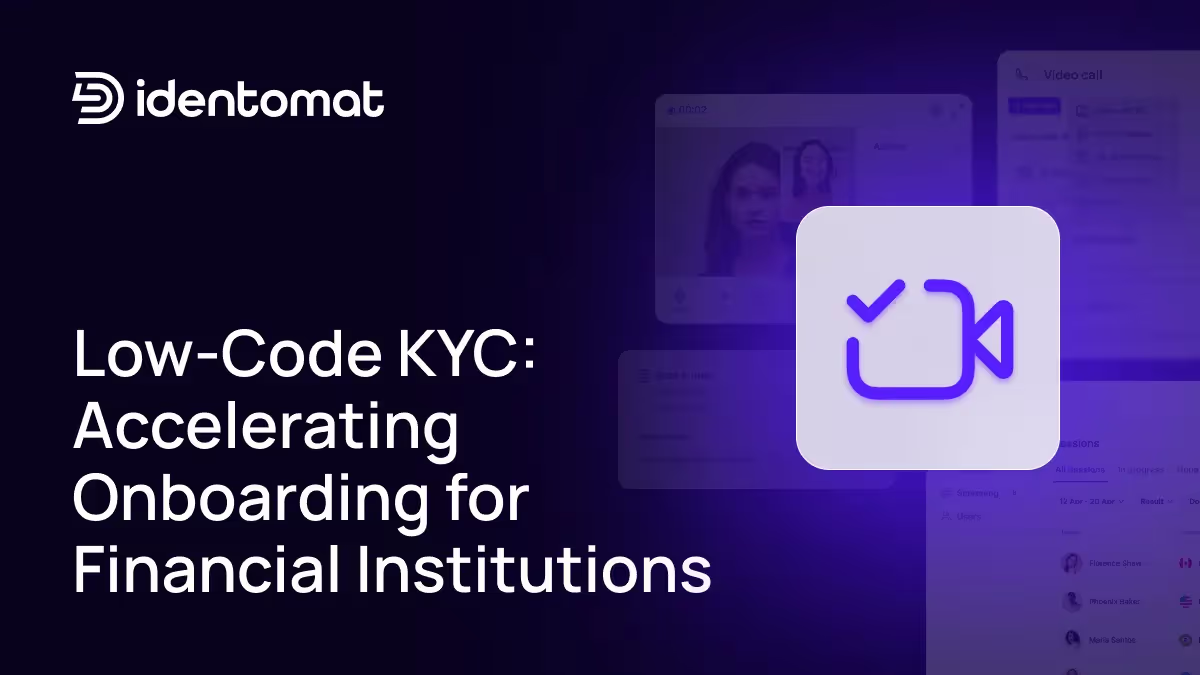

Financial institutions today operate in an environment where regulatory requirements evolve rapidly, customer expectations are rising, and digital onboarding speed directly affects competitiveness. Traditional KYC implementations - often hard-coded into backend systems - have long created friction between compliance teams, product owners, and engineering departments.
As institutions expand into new markets and introduce new digital services, onboarding flows need to adapt frequently.
This is where low-code KYC approaches are gaining attention: they allow organizations to configure onboarding journeys, compliance rules, and verification steps without rebuilding systems from scratch.
Understanding what low-code actually means in a regulated context - and how to evaluate such platforms - is becoming a key part of modern banking infrastructure decisions.
Are There Low-Code Solutions for KYC and Onboarding in Banking?
Yes, modern KYC platforms increasingly offer low-code and configurable onboarding workflows designed specifically for financial institutions.
These platforms allow teams to design and adjust identity verification flows, compliance checks, and onboarding journeys through configuration interfaces rather than requiring constant engineering intervention.
However, low-code in banking does not mean zero engineering.
Regulated onboarding involves complex integrations, data handling requirements, and compliance logic. Most implementations still rely on APIs, SDKs, and backend services. What low-code solutions provide is reduced dependency on development teams for operational changes.
Instead of rebuilding systems every time a regulation changes or a new market is entered, teams can adjust workflows through configuration layers.
For example, a compliance team might need to:
- Add an AML screening step for customers from specific jurisdictions
- Introduce liveness detection for high-risk segments
- Modify identity verification requirements for certain products
- Update onboarding logic after regulatory changes
In traditional systems, these adjustments often require development cycles, deployment pipelines, and QA processes.
With low-code onboarding platforms, these changes can be configured through workflow tools or rule engines - significantly reducing time-to-market.
That said, flexibility varies widely across providers. Some platforms offer limited configuration options, while more high-achieving companies provide deeper workflow orchestration capabilities (no-code workflow) that allow institutions to adapt onboarding logic more dynamically.
For banks and fintechs evaluating vendors, understanding this distinction is critical.
What Does Low-Code KYC Really Mean in a Banking Context?
In regulated environments like banking, low-code functionality typically appears in several key layers of the onboarding infrastructure.
Visual Workflow Configuration
One of the most visible aspects of low-code KYC platforms is a visual workflow builder.
These interfaces allow teams to design onboarding journeys through graphical tools rather than code. Instead of modifying backend logic, users configure the sequence of steps customers go through during identity verification.
Typical capabilities include:
- Drag-and-drop onboarding flow design
- Conditional branching based on risk signals
- Different paths for different customer segments
- Step-by-step verification orchestration
With configurable workflow builders, verification steps can be rearranged or expanded depending on product type, jurisdiction, or customer risk level. Conditional logic can also route users dynamically - for instance, sending higher-risk customers through additional verification layers.
Modular Verification Components
Another key aspect of low-code KYC systems is modular verification infrastructure. Instead of hard-coded verification flows, modern platforms often offer a set of verification modules that can be combined in different ways.
Common modules include:
- ID verification
- AML and sanctions screening
- Liveness detection
- Video KYC
- Address verification
- PEP checks
- Document authentication
These modules function as configurable building blocks.
A bank onboarding customers in one jurisdiction might require document verification and AML checks, while another jurisdiction may require additional address verification or video KYC.
This modular structure also enables risk-based onboarding. Low-risk customers may complete onboarding through automated document verification and liveness checks, while higher-risk cases can trigger enhanced due diligence steps.
Rule-Based Compliance Logic
Low-code KYC platforms typically provide rule-based systems that allow compliance teams to configure decision logic without writing code.
Examples include:
- Triggering enhanced verification for certain countries
- Setting risk thresholds for automated approvals
- Routing flagged users to manual review
- Configuring ongoing monitoring triggers
Institutions expanding into new regions may need to introduce additional checks for customers from specific regulatory zones. Rule-based configuration allows these adjustments without modifying backend code.
API + Low-Code Hybrid Architecture
No-code configuration has become an important capability in modern onboarding platforms. It allows compliance and product teams to adjust onboarding journeys, verification steps, and decision rules without relying on engineering resources for every operational change.
However, in regulated financial environments, onboarding infrastructure must also integrate deeply with banking systems, risk engines, and internal data sources. Because of this, most modern platforms combine no-code configuration layers with API-driven infrastructure.
In this model:
- APIs provide system integration
- SDKs support product-level integration
- Configuration layers enable operational adjustments
Engineering teams handle the initial integration and architecture, while compliance and product teams manage workflow configuration.

The Operational Cost of Hard-coded KYC Workflows
Many financial institutions still rely on onboarding systems where verification logic is embedded directly within backend services. Over time, this architecture creates operational constraints.
Regulatory Change Frequency
Regulatory requirements rarely remain static. AML directives, digital identity frameworks, and jurisdiction-specific rules change regularly. Hard-coded systems require development work whenever regulations evolve, slowing response times.
Engineering Backlogs
When onboarding logic is tightly coupled with backend code, even minor workflow changes require development resources. Compliance updates often compete with core product development in engineering roadmaps.
Vendor Lock-In
Some legacy onboarding vendors provide limited configurability, forcing institutions to rely on vendor-side implementation for updates.
Delayed Go-To-Market
Launching new financial products often requires adapting onboarding flows.
For example:
- A digital lending product may require additional verification steps
- A crypto offering may require enhanced AML checks
- Cross-border expansion may introduce new regulatory requirements
Hard-coded onboarding workflows can slow these initiatives.
Product Iteration Constraints
Digital banking products evolve continuously. Institutions frequently refine onboarding flows to improve conversion rates and risk assessment. Low-code infrastructure allows teams to modify onboarding journeys without engineering re-deployments.
What KYC Platforms Allow Low-Code or No-Code Journey Configuration?
Many modern KYC platforms now offer workflow configuration dashboards designed to support flexible onboarding journeys.
Some solutions allow only minor adjustments, while others enable institutions to design complex onboarding logic through configuration tools.
When evaluating low-code onboarding platforms, financial institutions should consider several criteria.
Key Evaluation Questions
- Can compliance teams modify rules without code?
- Can onboarding steps be reordered easily?
- Can onboarding flows vary by jurisdiction?
- Does configuration require engineering redeployment?
The Architecture Behind Truly Configurable Onboarding
Achieving flexible onboarding infrastructure requires more than adding a workflow builder on top of existing systems. Modern identity verification platforms increasingly rely on modular compliance architectures.
- Modular Compliance Engines
- Configurable Onboarding Flows
- Risk-Based Rule Engines
- API-First Infrastructure with Configuration Layers
How Low-Code KYC Accelerates Time-to-Market and Reduces Operational Risk
Low-code onboarding infrastructure changes how institutions deploy and scale digital financial services.
Faster Product Launches
Configurable onboarding workflows allow institutions to launch new financial products without rebuilding verification infrastructure.
Easier Market Expansion
Institutions entering new jurisdictions can introduce additional compliance steps without redesigning onboarding systems.
Lower Maintenance Costs
Separating compliance logic from application code simplifies system maintenance.
Regulatory Responsiveness
Compliance rule changes can be implemented through configuration rather than redevelopment.
Reduced Onboarding Drop-Offs
Institutions can refine onboarding flows and verification sequences to improve conversion while maintaining compliance standards.
As digital banking ecosystems continue to evolve, onboarding infrastructure must support both regulatory precision and operational agility.
Low-code KYC platforms provide a practical approach for institutions seeking configurable compliance workflows while maintaining the technical depth required for secure, scalable financial services.
Explore how a modular, no-code configurable onboarding platform can help your team design and adjust verification workflows, adapt compliance rules as regulatory requirements evolve, and launch new onboarding journeys without creating engineering bottlenecks.
See how configurable KYC infrastructure works in practice and how teams can manage onboarding flows with greater flexibility and control.
See Identomat in action. Request a demo here.
Ready to get started?
Empower your platform with Identomat's cutting-edge KYC and AML ID verification.
Book a demo
Frequently asked questions
Will a low-code configuration layer increase latency and slow down the user experience?
No. Modern modular compliance engines are designed for real-time processing. Because low-code platforms use dynamic branching—meaning users only go through the necessary checks based on their risk profile—the overall processing time is often faster than legacy systems that force every user through a static, heavy verification loop.
How long does it take to migrate from a hard-coded KYC system to a low-code platform?
Migration timelines depend on the complexity of your legacy system, but a modern API-first platform can typically be integrated in weeks rather than months. The process generally involves an initial engineering sprint to connect the core APIs and SDKs, after which the compliance and product teams take over to build and refine the actual workflows visually.
Why are hard-coded KYC systems an operational risk?
Hard-coded systems create engineering bottlenecks and slow down go-to-market strategies. Every time an AML regulation changes or a bank expands into a new jurisdiction, hard-coded logic requires extensive redevelopment, testing, and deployment, which drives up costs and delays compliance updates.