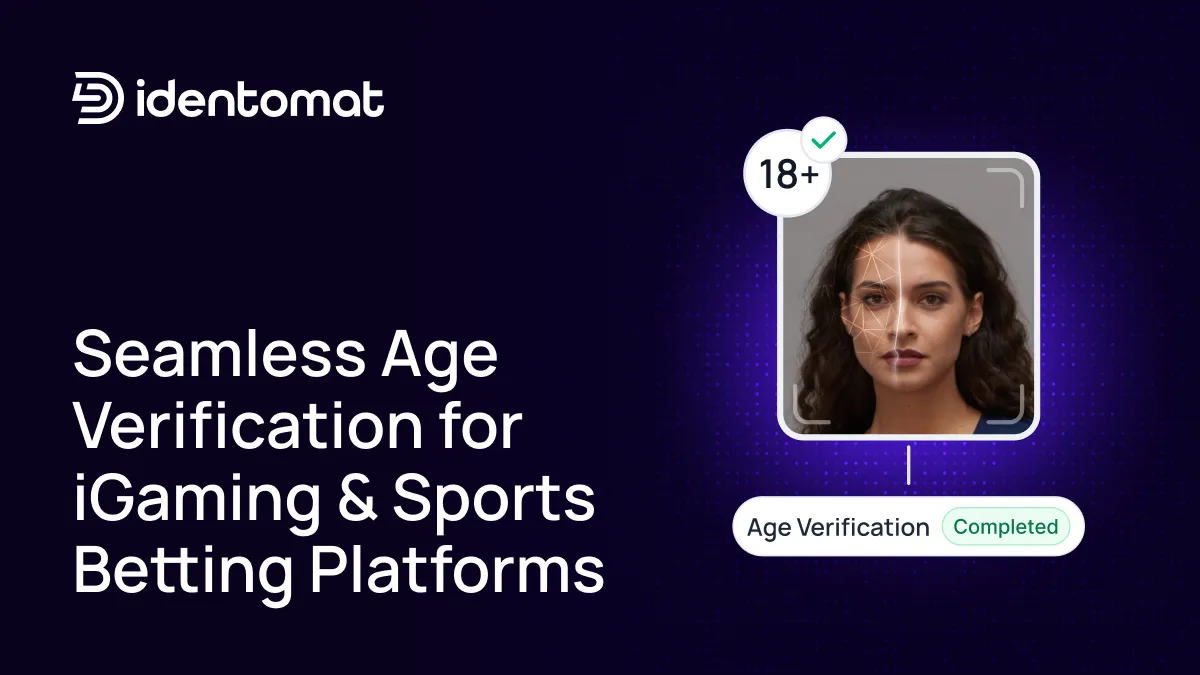

Age verification in iGaming and sports betting should be simple in principle. An operator needs to prevent underage access, meet licensing obligations, and keep legitimate players moving. In practice, age verification gets messy fast. Jurisdictions differ. Document types differ. Risk levels vary. Players expect speed. That mix of variables is exactly why “enter your birthday and move on” is not a serious solution. A modern age verification flow needs to be defensible, fast, and adaptable across markets.
A seamless setup does not mean a weaker setup. A seamless setup means the verification step does its job without creating avoidable friction. The distinction between verification and process bottlenecks matters in iGaming and sports betting, where onboarding is part compliance control and part conversion moment. If the flow is too light, the operator creates regulatory and reputational risk. If the flow is too heavy, the operator loses legitimate users before the first deposit or bet. A strong age verification model must hold both points at once.
Age verification is a regulatory requirement, not a design preference
The starting point is simple. Online gambling operators are expected to verify age before gambling begins. Regulators - such as the UK Gambling Commission and the Malta Gaming Authority - are clear: operators must ask users to prove age and identity before they gamble. In other words, age verification is not an optional optimization; it is a basic compliance obligation.
That matters globally because, while the exact rules may vary, the underlying expectation does not. Operators need a way to prove that access was restricted correctly and that checks were performed before regulated activity began. A self-declared birthday does not do that well.
Seamless age verification starts with real evidence
A strong flow begins with a government-issued ID. This document provides the most practical transition from a user’s unverified claim of age to a verified, compliant confirmation of their status. A high-quality flow starts with a quick ID capture, then extracts the date of birth and validates it across document zones and security features. This approach is critical because the operator is not just reading a birthday field; they are verifying that the entire document is consistent, authentic, and tamper-free.
This is also where the operational reality of global growth becomes critical. A sports betting or iGaming platform does not need age verification only for one domestic document type. Cross-border growth brings passports, national IDs, driver’s licences, residence permits, and different document layouts into the same onboarding funnel. A seamless global flow depends on universal document coverage, because expansion becomes prohibitively expensive when a platform has to juggle multiple, fragmented verification providers to cover different jurisdictions. Maintaining disparate stacks across regions creates unnecessary technical debt and operational complexity. A truly global age verification flow requires a unified approach that can handle diverse document types from the very first step of the process.
Seamless does not mean invisible. Seamless means fast and clear.
Age verification should be easy to understand from the player side and efficient to operate from the operator side. A strong age verification flow should guide the user, collect the right evidence, and return a clear outcome without dragging the case into unnecessary manual review. A robust structure is built around four simple steps:
- Capture the ID
- Verify the age
- Optionally confirm a real person is present
- Return a clear pass or fail result with audit-ready logs
The operational benefits are clear: fast capture, automated decisions, minimal manual workload, and higher conversion for legitimate users. A seamless setup reduces drag for both the player and the operator.
A global flow needs configurable policy logic
Not every market has the same threshold. Not every product has the same threshold either. A sportsbook, a casino product, and other age-restricted digital services may not always follow identical eligibility rules across jurisdictions. A strong age verification setup must support granular policy logic that adapts to different age thresholds, regional compliance requirements, and product-specific risks. An operator should be able to define unique verification rules for a sportsbook in one jurisdiction, a casino product in another, and a casual gaming app in a third - all from a single, centralized control point. That ability to apply specific, market-aware constraints is what elevates a verification setup from a generic digital check to a truly global compliance engine.
Some cases need more than a date-of-birth check
Age verification is the core job, but it is not always the only job.
An optional liveness step confirms the user is present and can be matched to their document. Regulators often note that operators may ask for additional verification when there are fraud concerns, such as when someone creates an account using another person’s details. That matters because a document is only useful if the person presenting it is genuine. In lower-risk cases, age verification may be sufficient; in higher-risk or suspicious cases, the operator may need greater assurance.
A well-designed setup allows the operator to use stronger checks where justified, while keeping straightforward cases fast. This requires optional liveness when needed, automated decisions when possible, and fewer cases landing on the compliance team’s desk by default.
Seamless age verification should fit the broader onboarding journey
Age verification works best when it is not isolated from the rest of onboarding. The ideal setup is a modular verification stack that includes Age Verification, ID Verification, Liveness Check, AML Screening, and related tools. This combination matters in iGaming and sports betting because operators rarely care only about age. A disconnected age gate can pass a player and still leave the operator with more work two steps later. A connected onboarding setup reduces that handoff problem, providing a cleaner decision path and a clearer audit trail.
What seamless global age verification actually looks like
At this point, the picture is fairly clear. A seamless global age verification flow for iGaming and sports betting platforms should:
- Use government-issued ID instead of self-declared birthdays
- Support broad international document coverage
- Extract and validate date-of-birth data automatically
- Return a clear decision quickly
- Support liveness check
- Allow different age policies by market, product, or risk level
- Fit into the wider onboarding and compliance journey
The goal is not a flashy age gate. The goal is a verification step the operator can trust, the regulator can understand, and the player can complete without frustration.
Conclusion
Seamless age verification is not about making the check disappear. It is about making the check reliable, fast, and easy to operate across markets. Moving beyond static age gates requires a sophisticated approach to data orchestration.
Identomat addresses this by consolidating the entire verification lifecycle into a single, intelligent flow. By integrating automated document authentication, biometric assurance, and configurable policy logic, Identomat empowers operators to replace internal friction with seamless, audit-ready compliance. When enhanced assurance is required, Identomat's liveness verification confirms user presence in real time. Furthermore, as onboarding requirements evolve, the same architecture seamlessly extends to include AML screening, video-based KYC, and comprehensive identity management.
If your platform needs global age verification that protects minors, supports compliance, and keeps legitimate players moving, explore how Identomat's Age Verification, ID Verification, and Liveness Check can work together in one onboarding flow.
Ready to get started?
Empower your platform with Identomat's cutting-edge KYC and AML ID verification.
Book a demo
Frequently asked questions
How does the system prevent a minor from simply scanning their parent’s ID?
While automated document extraction confirms the ID is real and the age is over 18/21, it cannot prove who is holding the phone. This is why top-tier iGaming operators mandate a Biometric Face Match alongside the ID upload. By requiring a real-time liveness check, the system mathematically ensures the face looking into the camera belongs to the adult pictured on the ID, completely neutralizing "borrowed ID" or "sibling" fraud.
Do players have to wait in a manual review queue before making their first deposit?
No. In modern sports betting, speed is the ultimate conversion lever. AI-driven document verification and biometric checks process in seconds, allowing legitimate players to deposit and play almost instantly. Manual review (often called Human-in-the-Loop) is only triggered dynamically as a fallback for severe edge cases - such as highly damaged documents or extreme camera glare - keeping your automatic pass rates high and First Time Deposits (FTDs) intact.
How do operators handle data privacy and GDPR when collecting IDs for gambling?
Player trust is critical; many users abandon onboarding if they feel their data is insecure. Enterprise-grade KYC providers solve this through tokenization. Instead of the iGaming platform storing toxic data (like ID images and biometrics) on their own servers, the verification platform securely processes the data and sends the operator a cryptographic "Pass/Fail" token along with the verified age. This keeps the operator fully compliant with GDPR and CCPA without the liability of hosting sensitive PII.